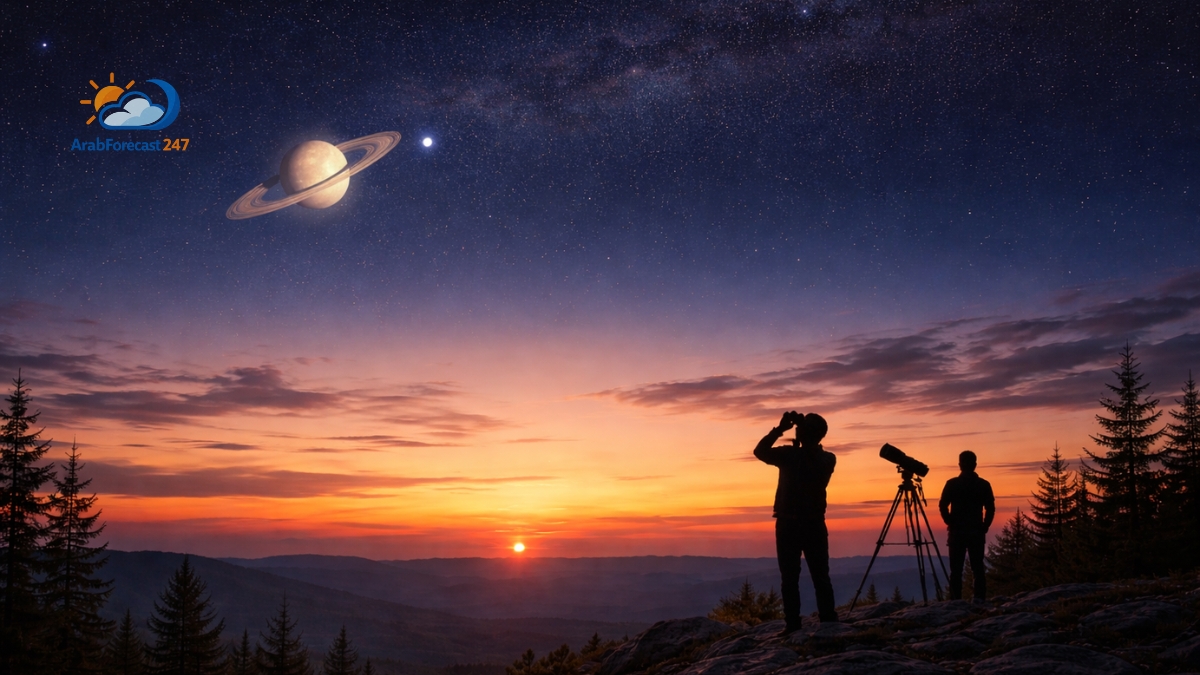
A remarkable celestial event is unfolding in the evening sky as Saturn and Neptune align in a rare planetary conjunction. Skywatchers have not seen these two distant giants appear this close since 1989. After this encounter, the next similar alignment will not occur until 2062.
For astronomy enthusiasts and casual observers alike, tonight presents a rare opportunity to witness a slow-moving cosmic dance that marks the beginning of a new 36-year planetary cycle.
If you plan to step outside, timing and location will be key.
What Is the Saturn Neptune Conjunction?
A planetary conjunction occurs when two planets appear very close together in the sky as seen from Earth. While they remain separated by vast distances in space, their orbital paths align from our perspective, creating the illusion of proximity.
In this case, Saturn and Neptune, two of the Solar System’s outer planets, are aligning in the western evening sky.
These conjunctions are rare because:
- Saturn takes about 29.5 years to orbit the Sun
- Neptune takes roughly 165 years to complete one orbit
- Their cycles intersect only once every 36 years
The last Saturn–Neptune conjunction occurred in 1989. After tonight, observers will need to wait until 2062 for another similar event.
When and Where to Watch
To see the conjunction clearly, look toward the western sky 30 to 60 minutes after sunset.
Viewing Tips
- Choose a location with a clear, unobstructed western horizon
- Avoid city lights for better visibility
- Allow your eyes 15–20 minutes to adjust to darkness
Saturn will be visible to the naked eye, shining steadily like a bright star. Neptune, however, is much fainter and typically requires binoculars or a small telescope to detect.
The two planets will appear so close that both can fit within the same binocular field of view a rare and striking sight.
Why This Alignment Matters
While conjunctions occur regularly between faster-moving inner planets, alignments between slow-moving outer planets are far less frequent.
This particular event is significant for several reasons:
1. It Marks a New 36-Year Planetary Cycle
Astronomers note that Saturn–Neptune conjunctions initiate long-term cycles that reflect the rhythm of the outer Solar System. These cycles influence planetary dynamics and are studied to better understand orbital mechanics.
2. A Once-in-a-Generation Sight
For many people alive today, this could be the only Saturn–Neptune conjunction they witness in their lifetime. The 36-year interval means younger observers may have another chance in 2062, but older generations likely will not.
3. A Reminder of Cosmic Timescales
Events like this highlight how slowly and beautifully our Solar System moves. While daily life feels fast-paced, planetary alignments operate on decades and centuries.
It is a humbling reminder of Earth’s place in a much larger system.
Can You See Neptune Without Equipment?
Saturn will shine brightly and clearly to the naked eye. Neptune, however, is extremely faint.
In most locations:
- Saturn: Visible without optical aid
- Neptune: Requires binoculars or a telescope
- Best results: 7×50 or 10×50 binoculars
Even with binoculars, Neptune may appear as a dim bluish dot next to Saturn. The real beauty of this event lies in seeing both planets together in one frame.
Best Conditions for Viewing
Clear skies are essential. Clouds, haze, or dust can quickly obscure Neptune.
Ideal observing conditions include:
- Low humidity
- Minimal light pollution
- Calm atmospheric conditions
- A high, unobstructed western horizon
If weather conditions are poor tonight, check local astronomy clubs or observatories for live streams or updates.
The Science Behind Planetary Conjunctions
Conjunctions happen because all planets orbit the Sun along roughly the same flat plane, known as the ecliptic.
From Earth’s perspective, planets occasionally appear to line up. However, they remain separated by millions or billions of kilometers.
Saturn is located about 1.4 billion kilometers from the Sun, while Neptune lies nearly 4.5 billion kilometers away. Despite this vast distance difference, orbital timing brings them visually close together at predictable intervals.
Astronomers use precise mathematical models to forecast these alignments decades in advance.
What Happens After Tonight?
The two planets will remain relatively close for a short period, but tonight represents their tightest visual approach.
Over the coming weeks:
- Saturn will slowly drift away
- Neptune will continue its gradual motion
- The conjunction will fade
Missing this alignment means waiting until 2062 for the next similar event.
Why Celestial Events Matter
Astronomical phenomena like the Saturn–Neptune conjunction spark curiosity and reconnect people with the night sky.
In an era dominated by screens and artificial light, stepping outside to observe a rare planetary alignment offers a moment of perspective.
It reminds us that:
- The Solar System is constantly moving
- Time operates on cosmic scales
- Rare events reward patience
For educators, students, and families, this is also a valuable opportunity to inspire interest in science and space exploration.
Frequently Asked Questions
1. What time is the Saturn Neptune conjunction visible?
Look toward the western sky 30 to 60 minutes after sunset for the best viewing window.
2. Can I see Neptune without a telescope?
Neptune is too faint for the naked eye. Binoculars or a small telescope are recommended.
3. How often do Saturn and Neptune align?
Approximately every 36 years.
4. When was the last Saturn Neptune conjunction?
The previous alignment occurred in 1989.
5. When will the next one happen?
The next conjunction is expected in 2062.