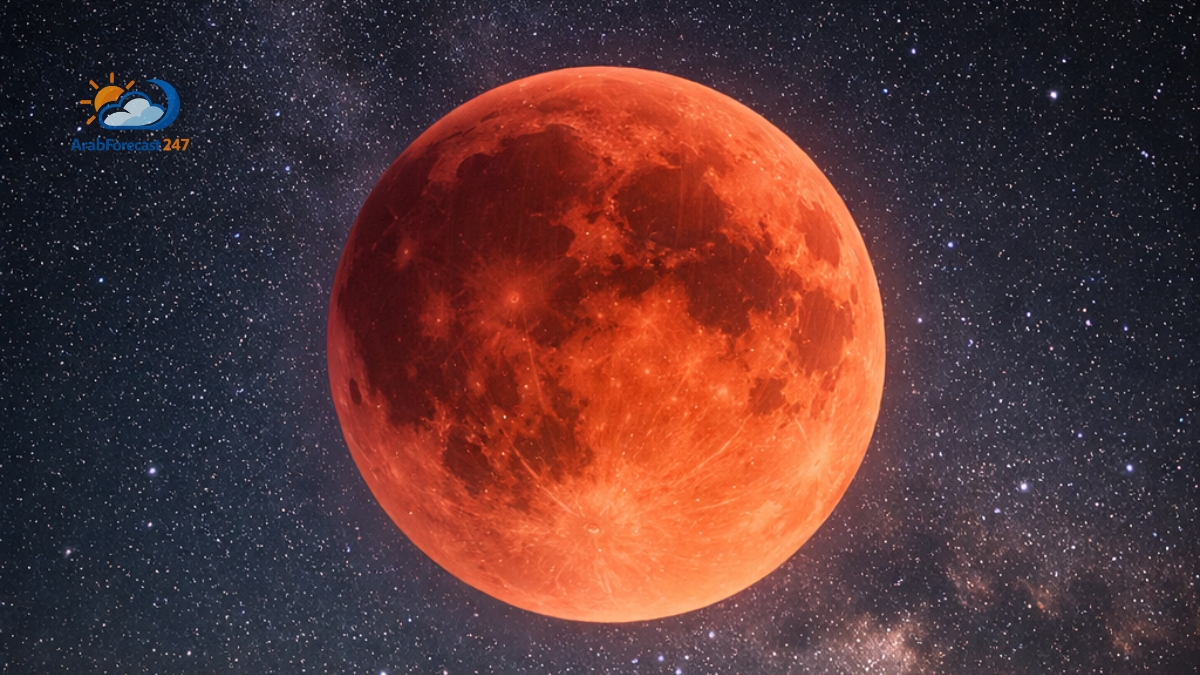
A spectacular Blood Moon total lunar eclipse is set to captivate skywatchers across the globe, offering nearly an hour of deep red lunar beauty. For the third consecutive time, the Moon will pass completely into Earth’s shadow, creating one of the most dramatic celestial events visible to the naked eye.
With around 2.5 billion people positioned to witness the phenomenon, this rare event promises to be an unforgettable night under the stars.
What Is a Blood Moon Total Lunar Eclipse?
A total lunar eclipse occurs when Earth moves directly between the Sun and the Moon, casting its shadow across the lunar surface. During this alignment, the Moon transitions through different phases of shadow before turning a deep copper-red hue.
Unlike a solar eclipse, this event is completely safe to view without special equipment.
Why Does the Moon Turn Red?
During totality, the Moon does not disappear into darkness. Instead:
- Earth’s atmosphere bends sunlight toward the Moon
- Shorter blue wavelengths scatter away
- Longer red wavelengths pass through
- The Moon glows in shades of red and copper
The effect is created by every sunrise and sunset happening on Earth at that moment, making it one of the most visually striking astronomical events.
Full Lunar Eclipse Schedule (UTC)
Here is the official timeline for the eclipse in Coordinated Universal Time (UTC):
- Partial eclipse begins: 09:50
- Total eclipse begins: 11:04
- Peak eclipse (maximum): 11:34
- Total eclipse ends: 12:02
- Partial eclipse ends: 13:17
The phase of full redness, known as totality, will last 58 minutes, while the entire eclipse journey will span more than three hours.
Who Will See the Best Views?
Clear visibility is expected across several major regions.
Prime Viewing Locations
- North America
- Pacific region
- Australia
- Eastern Asia
Observers in these areas will experience the most dramatic and unobstructed views, weather permitting.
Those outside these zones may still see partial phases depending on local timing and sky conditions.
For live tracking and global visibility maps, skywatchers often refer to organizations such as NASA and European Space Agency.
How to Watch the Blood Moon
One of the greatest advantages of a total lunar eclipse is its accessibility.
You do not need:
- Telescopes
- Special eclipse glasses
- Protective filters
You may want:
- Binoculars for enhanced detail
- A tripod-mounted camera for long exposures
- A dark location away from city lights
Urban viewers can still enjoy the eclipse, but rural or desert locations offer clearer skies and deeper color contrast.
What Makes This Eclipse Special?
Astronomers note that this marks the third consecutive total lunar eclipse, a rare sequence that adds to the event’s significance.
Several factors make this eclipse remarkable:
- Long totality duration of 58 minutes
- Wide global visibility reaching 2.5 billion people
- Favorable viewing for major population centers
- Dramatic red coloration expected
While lunar eclipses are not extremely rare, sequences like this are less common and attract significant global attention.
The Science Behind Totality
When the Moon enters Earth’s umbra, the darkest part of its shadow, totality begins. At this stage:
- Direct sunlight is blocked.
- Earth’s atmosphere refracts sunlight.
- The red spectrum dominates.
- The Moon appears copper, crimson, or rusty orange.
The exact shade depends on atmospheric conditions, including dust, pollution, and volcanic particles.
Cleaner atmospheres produce brighter red tones. Increased atmospheric particles can create darker, more dramatic hues.
Tips for Photographing the Eclipse
Capturing a Blood Moon can be challenging but rewarding.
Recommended settings:
- Use manual mode
- Lower ISO during partial phases
- Increase ISO during totality
- Use a tripod to avoid motion blur
- Experiment with exposure times
Wide-angle shots that include landscapes or skylines often produce the most striking images.
Will Weather Affect Viewing?
Yes. Cloud cover is the only major obstacle.
Check local weather forecasts 24 to 48 hours in advance. Clear, dry skies offer the best viewing conditions.
Desert and coastal regions often provide stable visibility, but sudden cloud formations can obscure the Moon at peak moments.
Frequently Asked Questions
Is it safe to look at a total lunar eclipse?
Yes. Unlike solar eclipses, lunar eclipses are completely safe to view with the naked eye.
Why is it called a Blood Moon?
The name comes from the red coloration the Moon takes on during totality due to atmospheric light filtering.
How long will the red phase last?
Totality will last approximately 58 minutes.
How often do total lunar eclipses happen?
They typically occur once or twice a year, but consecutive total eclipses are less common.
Can I see it from the Middle East?
Visibility depends on timing. Some regions may see partial phases, while others may need live streams from global space agencies.
A Shared Global Experience
With billions able to witness the event, this Blood Moon serves as a reminder of our shared sky. Across continents, cultures, and time zones, millions will look up at the same glowing Moon.
It is a moment of unity, curiosity, and scientific wonder.
Conclusion: Look Up and Stay Curious
The upcoming Blood Moon total lunar eclipse promises nearly an hour of deep red lunar beauty, visible across multiple continents. With a full timeline already mapped out in UTC, skywatchers have everything they need to prepare.
Check your local forecast, step outside, and take a moment to witness this rare celestial alignment.