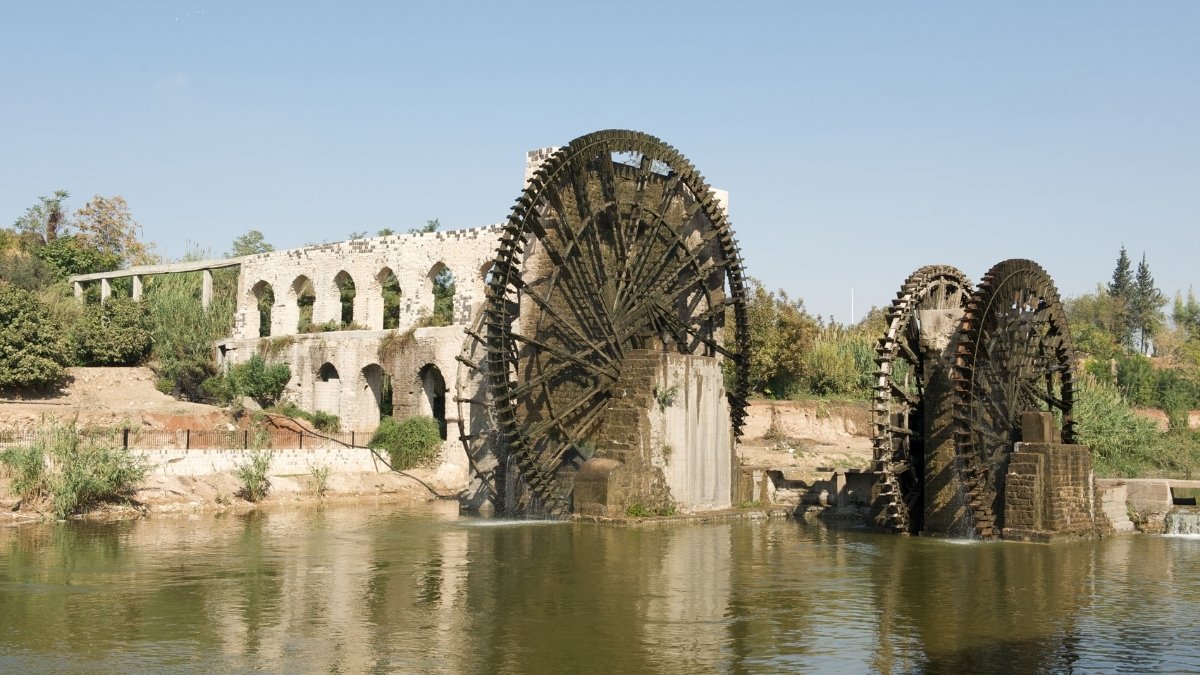
The giant wooden waterwheels of Hama are among the oldest surviving examples of large scale hydraulic engineering in the Middle East. For centuries, these massive wheels lifted water from the Orontes River to irrigate fields, supply homes, and sustain agriculture in one of Syria’s historic farming regions.
These structures, known as “Norias,” demonstrate how ancient societies in the Levant adapted to semi arid climates and seasonal river flow long before modern pumping technology existed.
Origins of the Hama Norias
Historical records suggest the Norias of Hama date back to the Byzantine period, although many historians believe the engineering tradition began even earlier during the Hellenistic era.
By the medieval Islamic period, Hama had developed a sophisticated network of water distribution channels.
Key characteristics of the early Norias included:
- Giant wooden wheels measuring 10 to 20 meters in diameter
• Clay or wooden water containers attached along the rim
• Aqueduct channels that carried lifted water into the city and nearby orchards
When the river current pushed the wheel, the containers filled with water and emptied into elevated canals, creating a continuous irrigation system powered entirely by river flow.
Climate and Water Challenges in the Orontes Valley
The region around Hama experiences a Mediterranean semi dry climate.
Typical weather patterns include:
- Summer temperatures between 30°C and 38°C
• Mild winters with averages of 8°C to 15°C
• Annual rainfall around 300 to 400 mm, mostly between November and March
Because rainfall is limited and irregular, managing river water efficiently has always been critical for farming communities along the Orontes Valley.
The Norias helped stabilize water supply during dry summers when crop irrigation demand was highest.
Engineering Design of the Waterwheels
The Norias were built almost entirely from wood and required constant maintenance due to moisture and seasonal flooding.
Despite this, their design proved extremely durable.
Important engineering features included:
- Large paddles that captured the river’s current
• Balanced circular frames to maintain rotation
• Elevated aqueducts that distributed water across farmland
Some wheels could lift thousands of liters of water every hour without fuel or animal labor.
This made them one of the most efficient renewable water systems of the ancient world.
Cultural and Historical Importance
Over time, the Norias became a defining symbol of Hama’s identity. Travelers and historians from across the Middle East documented the sound of the creaking wooden wheels echoing along the riverbanks.
At one point, more than 30 Norias operated simultaneously along the Orontes River.
Today, several restored wheels remain as historical landmarks, reflecting centuries of water management knowledge developed in the region.
Lessons for Modern Water Management
Ancient systems like the Hama Norias highlight how traditional societies adapted to hot climates and water scarcity using sustainable methods.
In regions across the Middle East and North Africa where summer temperatures regularly exceed 40°C and drought cycles are intensifying, historical water management strategies are gaining renewed attention.
Engineers studying these systems often focus on:
- Gravity based irrigation
• Renewable mechanical water lifting
• Low energy water distribution networks
These ideas continue to influence modern approaches to sustainable agriculture in arid environments.
Final Thought
The Norias of Hama are more than historic monuments. They are reminders that smart water management has always been essential in dry climates.